
Built for What’s Next: Traditional Digital Infrastructure vs. Purpose-Built Facilities
As AI and high-performance computing push computational demands to new extremes, one question has become unavoidable: is your existing data center built for what you need today — let alone tomorrow?
| Metric | Traditional Facility | Purpose-Built Facility |
|---|---|---|
| Cooling Type | Air-cooled (CRAC/CRAH) | Liquid / immersion cooling |
| Max Rack Density | 5–10 kW per rack | 100 kW+ per rack |
| Floor Load Rating | 150–250 lbs/sq ft | 300–500+ lbs/sq ft |
| PUE (Efficiency) | 1.5 – 2.0+ | 1.1 – 1.3 |
| Network Connectivity | Limited, single-carrier | Carrier-neutral, dark fiber |
| Power Redundancy | N or N+1 (legacy sizing) | 2N with HPC-scale UPS |
For decades, traditional data centers served the industry well. They housed rows of standard servers, managed predictable workloads, and operated within well-understood power and cooling envelopes. But the rules have changed. Modern workloads are denser, hotter, heavier, and more bandwidth-hungry than anything legacy facilities were designed to accommodate.
Purpose-built facilities — designed from the ground up with modern compute in mind — are closing the gap. Below, we break down the key differences across six critical dimensions.
Perhaps the single most pressing challenge facing traditional data centers today is thermal management. Legacy facilities were designed around air-cooled systems — computer room air conditioners (CRACs), hot/cold aisle containment, and raised floor plenums. For standard servers drawing 1–5 kW per rack, this approach was sufficient.
Modern AI accelerators and high-density compute nodes tell a very different story. A single rack equipped with today’s GPU clusters can exceed 100 kW — more than 20 times what legacy air-cooling systems were designed to handle. Trying to cool these loads with air alone is not just inefficient; in many cases, it is physically impossible.
- Direct Liquid Cooling (DLC): Coolant delivered directly to processor heat sinks via manifolds integrated into the rack, removing heat at the source.
- Immersion Cooling: Servers submerged in non-conductive dielectric fluid, enabling extreme heat dissipation with near-silent operation and significant energy savings.
- Rear-Door Heat Exchangers: A transitional approach integrating liquid cooling at the rack level without requiring a full facility retrofit.
- Precision-Engineered CDUs: Coolant Distribution Units sized for high-density deployments with redundant circuits and real-time monitoring.
Air cooling is reaching its physical ceiling. Purpose-built facilities engineered with liquid cooling aren’t a luxury — they are a prerequisite for next-generation compute.
Weight is an often-overlooked constraint that becomes immediately apparent when deploying modern infrastructure. Traditional data center floors were typically designed to support 150–250 lbs per square foot — adequate for the 1U and 2U servers of a prior era.
Today’s high-density configurations tell a different story. A fully loaded GPU server chassis can weigh over 100 lbs on its own. Multiply that across a fully populated 42U rack — adding cabling, PDUs, and networking gear — and a single rack can approach 2,000–3,000 lbs. Legacy raised flooring systems can buckle or fail under these loads, creating serious safety and liability risks.
- Reinforced concrete slab construction rated for 300–500+ lbs per square foot, engineered for high-density deployments.
- Structural steel framing with independent rack anchor points that distribute weight loads directly to the building foundation.
- Elimination of raised flooring in high-density zones, removing a critical failure point and improving airflow predictability.
- Per-rack weight ratings documented and enforced during facility design, preventing overload scenarios before they occur.
Ignoring floor load capacity is a safety and liability issue. Purpose-built facilities engineer weight distribution into the foundation — not as an afterthought.
Traditional data centers were built on the assumption that average rack densities would remain in the 5–10 kW range. Their electrical infrastructure — PDUs, busways, UPS systems, and generator capacity — reflects that assumption. Retrofitting these systems is possible, but costly, disruptive, and often limited by the physical constraints of the existing building.
- High-density power distribution: 3-phase PDUs rated for 30–60A circuits per rack, with in-rack branch circuit monitoring at the outlet level.
- Scalable UPS architecture: Modular lithium-ion UPS systems that can be right-sized and expanded without significant downtime.
- Generator capacity designed for peak load, sized on fully populated high-density configurations — not historical averages.
- On-site power redundancy (2N or N+1) eliminating single points of failure across the entire electrical pathway.
- Renewable energy integration: On-site solar, battery storage, and grid interconnects engineered into the original design.
Power infrastructure is the lifeblood of any data center. Purpose-built facilities deliver the electrical capacity and redundancy that modern AI and HPC workloads demand — without compromise.
In the age of cloud computing, hybrid infrastructure, and distributed AI workloads, connectivity is no longer a secondary consideration — it is a primary design criterion. Traditional facilities were often located based on real estate availability, with network connectivity provisioned after the fact. This leaves organizations dependent on limited carriers, exposed to single points of network failure, and far from the internet exchange points that minimize latency.
- Carrier-neutral meet-me rooms (MMRs) enabling direct cross-connects to dozens of network providers, cloud on-ramps (AWS Direct Connect, Azure ExpressRoute, Google Cloud Interconnect), and CDN providers.
- Dark fiber access with diverse entry points: Physically separate conduit pathways entering the building from different directions, eliminating the risk of a single fiber cut.
- On-net access to major cloud providers, reducing latency and cost for hybrid cloud architectures by keeping traffic off the commodity internet.
- High-density fiber infrastructure designed for 400G, 800G, and beyond — not retrofitted from legacy copper or lower-grade fiber plant.
- Low-latency positioning near major IXPs and metropolitan fiber hubs, making network performance a competitive advantage.
Connectivity determines how fast your data moves and how much you pay to move it. Purpose-built facilities treat network access as a core infrastructure investment — not an add-on.
Regulatory requirements for data handling, privacy, and security continue to grow more complex. Purpose-built facilities increasingly differentiate on security architecture and compliance posture as primary design objectives — not checkbox items added after commissioning.
- Multi-factor biometric access control at every secure perimeter, with full audit logging and video retention.
- Man-trap vestibule entry systems preventing tailgating and ensuring individual credentialing at every access point.
- Seismically braced, blast-resistant construction where regulatory or geographic requirements demand it.
- Dedicated compliance zones: Physically isolated cages, suites, or modules purpose-built for HIPAA, FedRAMP, PCI-DSS, and similar frameworks.
- 24/7/365 on-site security staffing with documented incident response procedures and regular third-party audits.
Power Usage Effectiveness (PUE) — the ratio of total facility power to the power delivered to IT equipment — is a fundamental efficiency metric. Legacy facilities commonly operate at PUEs of 1.5 to 2.0 or higher, meaning for every watt delivered to compute, an additional 0.5–1.0 watts is consumed by overhead systems like cooling and lighting.
Purpose-built modern facilities routinely achieve PUEs of 1.1–1.3, driven by efficient cooling design, LED lighting, and intelligent power management. Over the lifetime of a facility, this difference translates to millions of dollars in operating cost and a dramatically reduced environmental footprint.
Sustainability is no longer just about corporate responsibility — it is a cost and competitive advantage. Purpose-built facilities deliver measurably better efficiency from day one.
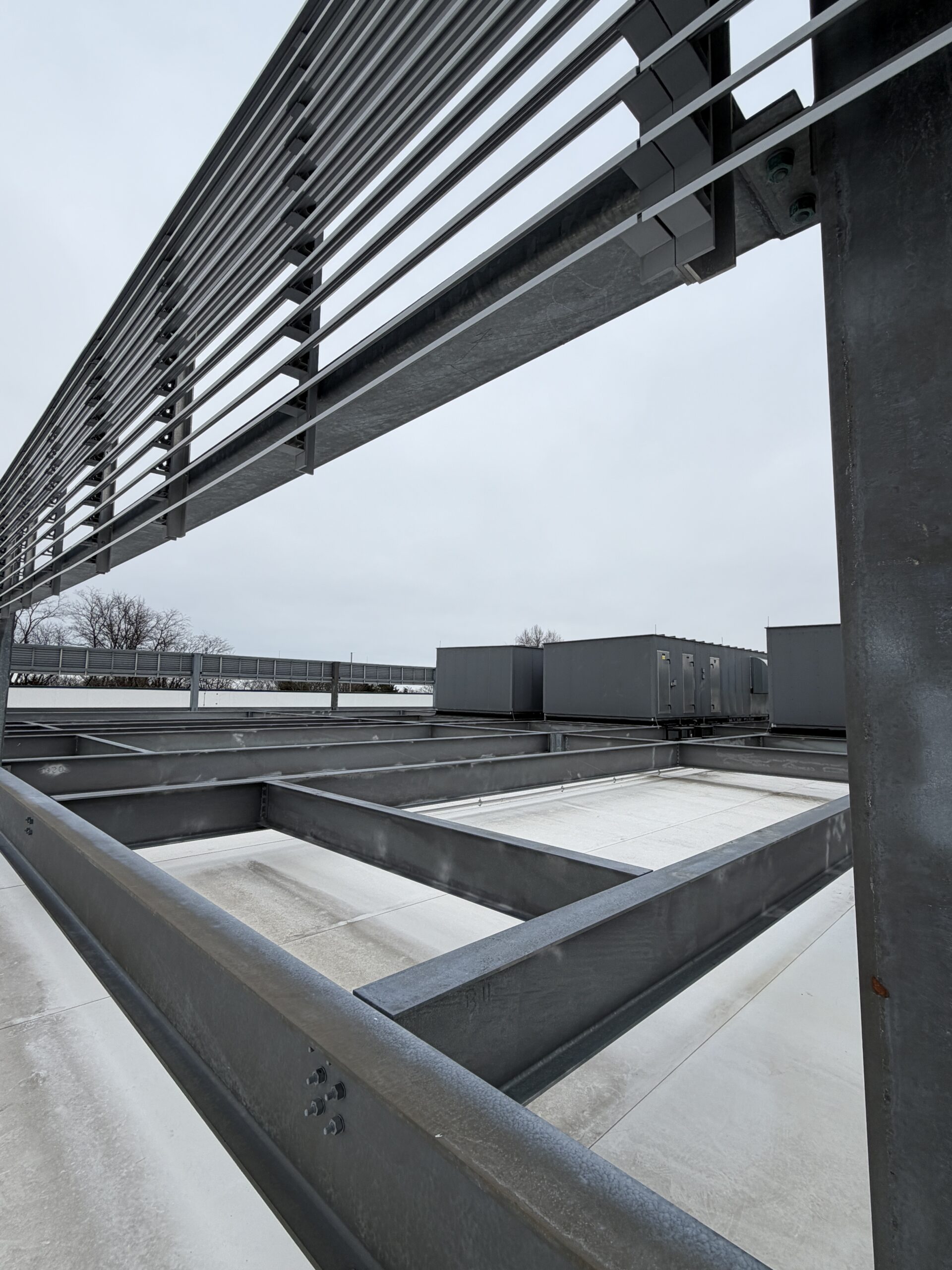
Steel on the Roof. The World’s First Liquid-Cooled CLS Is Taking Shape.
The structural framework for our 10MW data hall chiller system is installed and ready — a milestone years in the making.
The photographs below tell the story of what purpose-built really looks like. At our Wall Township, NJ campus, the structural steel framework is fully installed on the roof of our 10MW data hall — engineered by Bala from the slab up to carry the industrial-scale chiller systems that will make NJFX the world’s first Cable Landing Station with native liquid cooling for GPU-dense AI workloads.
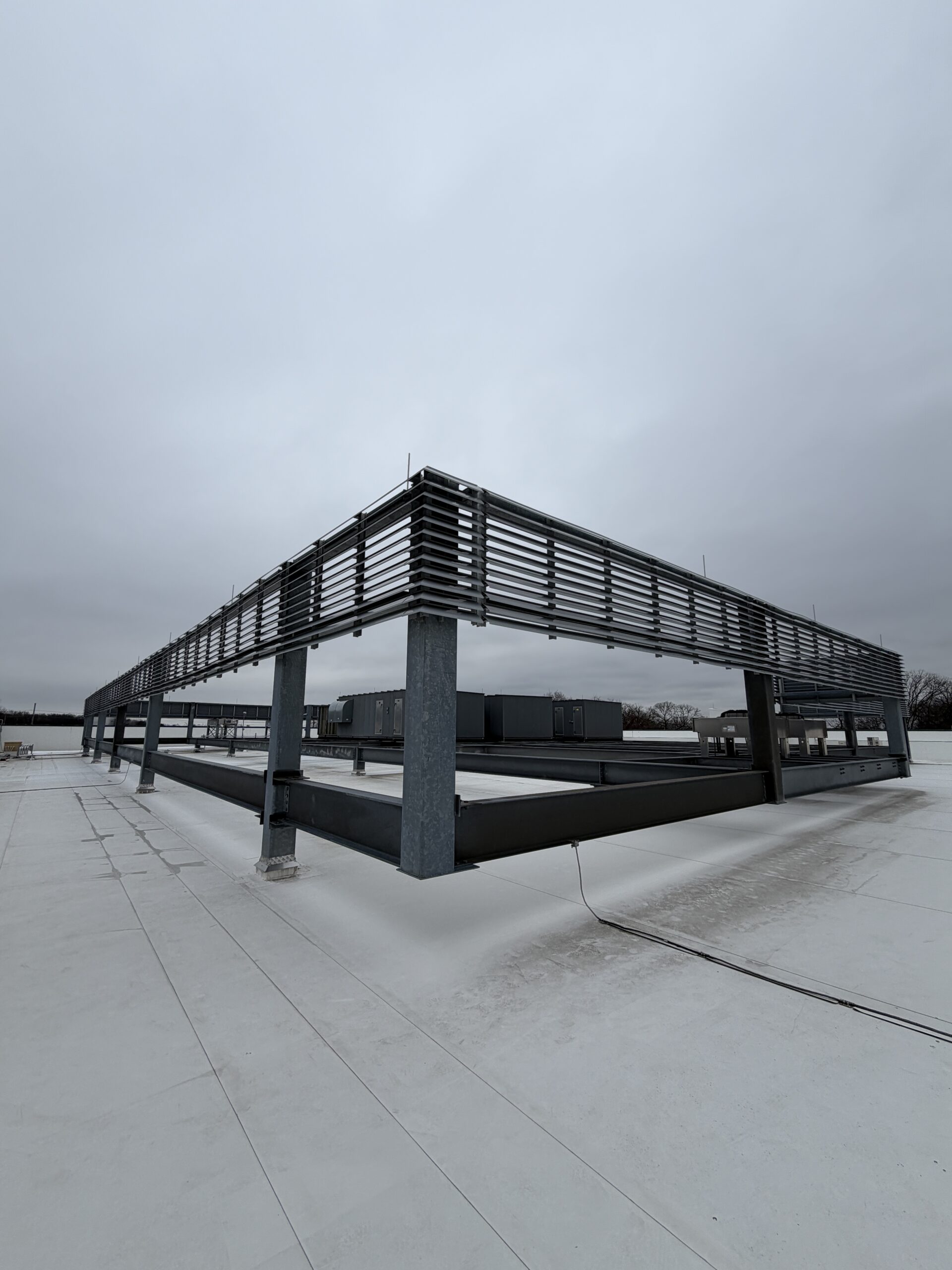
Steel framework complete on the roof of the 10MW data hall — load-rated and ready for chiller installation
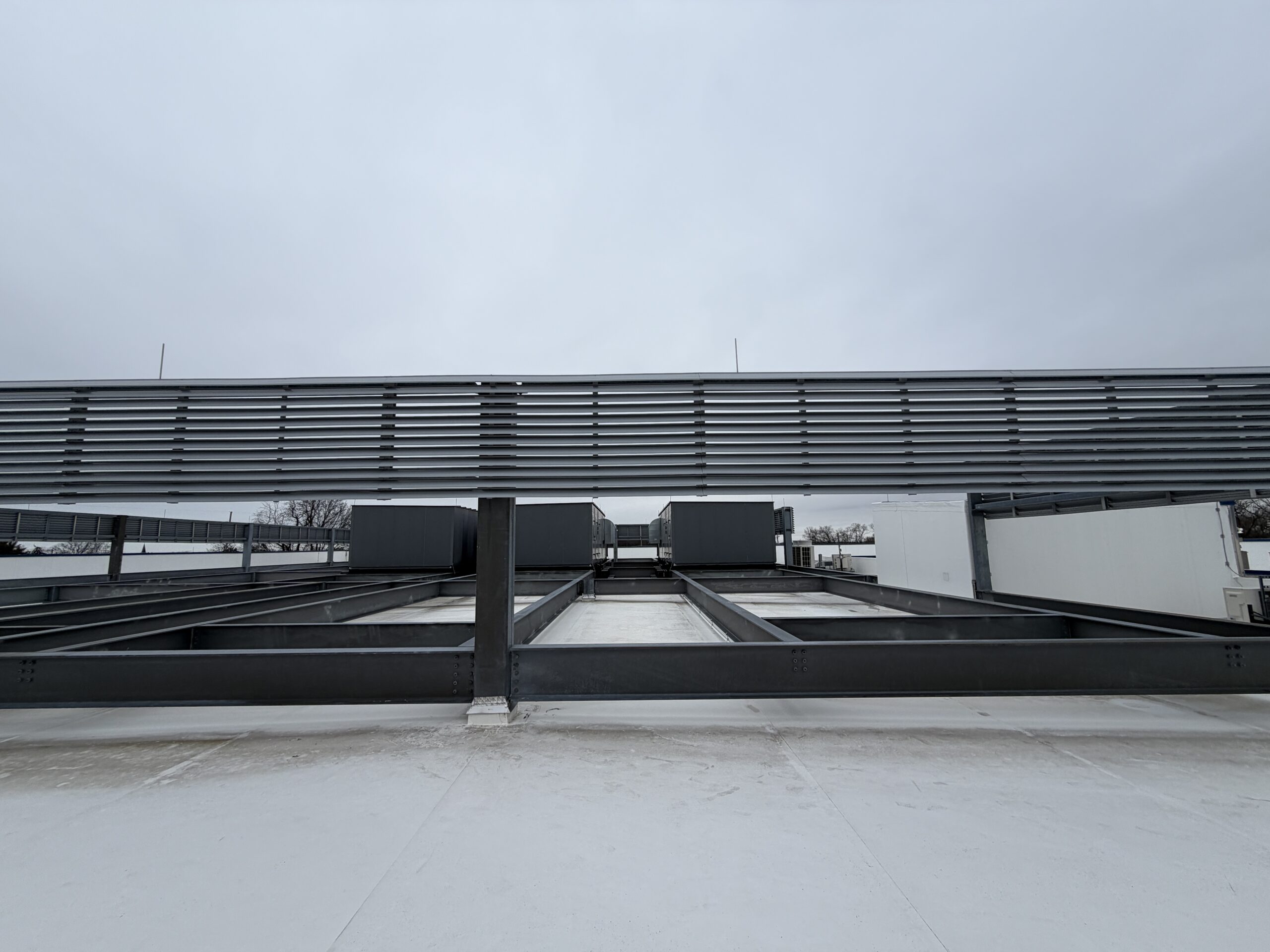
Wind-resistant screening bars engineered to withstand 155 mph Category 5 hurricane conditions — purpose-built for resilience from the outside in
Every beam, every connection — engineered for the loads that liquid cooling demands
This team built something no one has built before — a Cable Landing Station ready for liquid-cooled GPU infrastructure. Our customers can now land subsea traffic and run AI workloads in the same carrier-neutral campus. That combination doesn’t exist anywhere else in the world, and we’ve been building toward it from day one.
— Gil Santaliz, CEO & Founder, NJFXWhat you see in these images isn’t just steel. It’s the product of structural engineering, utility coordination, load calculations, and construction sequencing — all completed to support future infrastructure. The wind-resistant screening bars are rated to withstand 155 mph Category 5 hurricane conditions, and the structural steel grid is load-certified for industrial chiller tonnage. This is the kind of preparation that separates purpose-built facilities from legacy retrofits: when the equipment arrives, the building is ready for it.
Bringing a 10MW data hall online within a Cable Landing Station is not a single event. It is a precise sequence of interdependent milestones, each one enabling the next. NJFX has been ready at every step:
- ✓ Structural engineering completed — Rooftop steel grid designed and certified for industrial chiller load ratings
- ✓ Steel installation complete — Heavy-gauge structural framework installed and inspected across the full footprint
- ✓ Louvered screening structure installed — Airflow management canopy in place above the mechanical yard
- ✓ Utility power confirmed — 10MW load letter secured from utility partner with near-term energization schedule
- → Chiller installation underway — Industrial cooling equipment delivery and commissioning in progress
- → Data hall energization — Full 10MW capacity ready for customer deployment
Traditional data center infrastructure was designed for a different era of computing. That infrastructure served the industry well — but the demands of AI, high-density compute, and modern cloud-native workloads have fundamentally changed what “good” looks like.
Purpose-built facilities are not simply upgraded versions of their predecessors. They are purpose-engineered environments where every system — cooling, power, structure, connectivity, security — is designed as an integrated whole to support the most demanding workloads available today and the ones coming tomorrow.
For organizations evaluating their infrastructure strategy, the question is no longer whether purpose-built facilities offer advantages. The question is how long you can afford to operate without them.
Ready to Learn More?
Contact the NJFX team to discuss how our purpose-built campus can support your workloads.
