
Why Resilience Belongs at the Core of Your Network Architecture
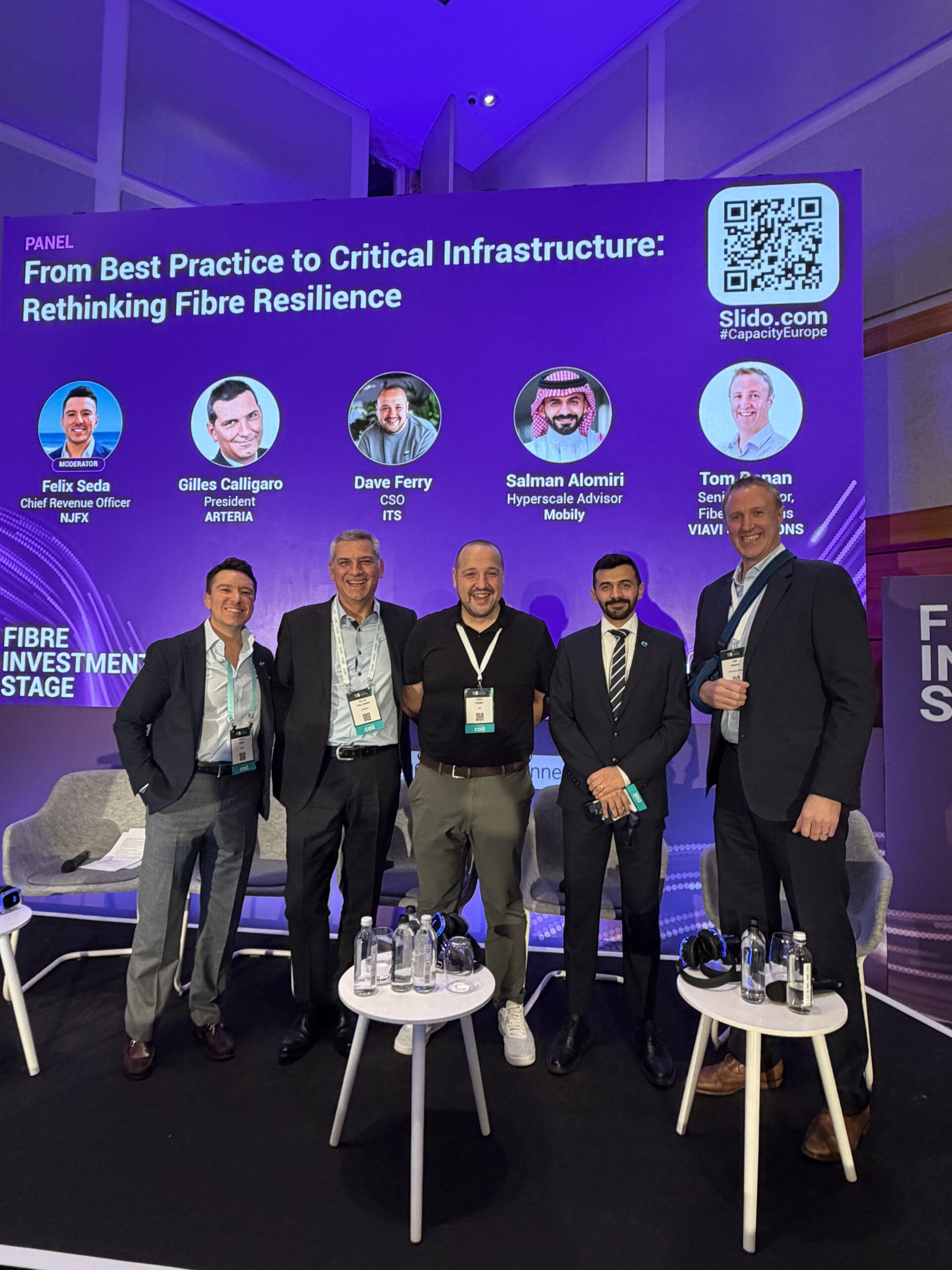
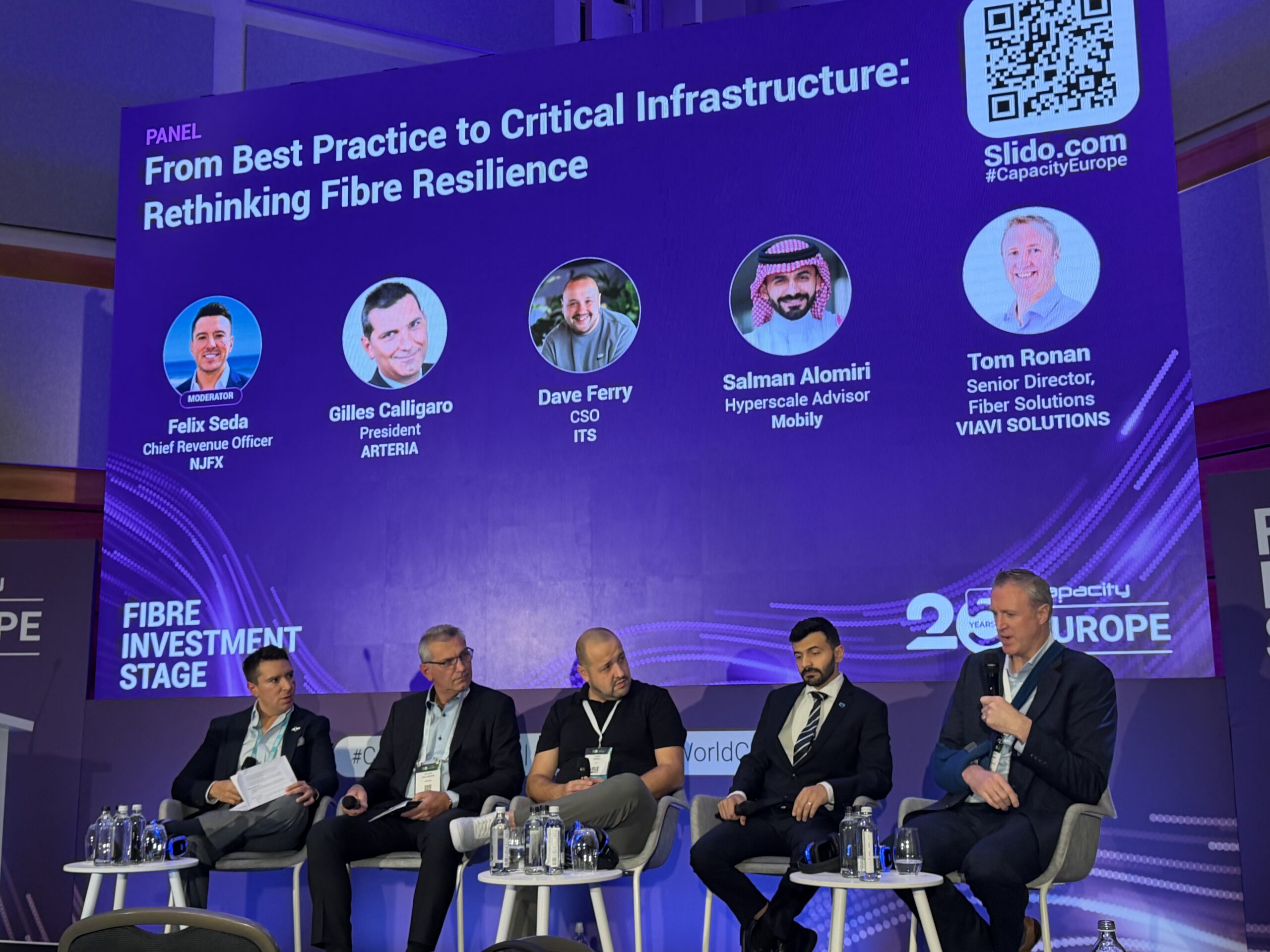
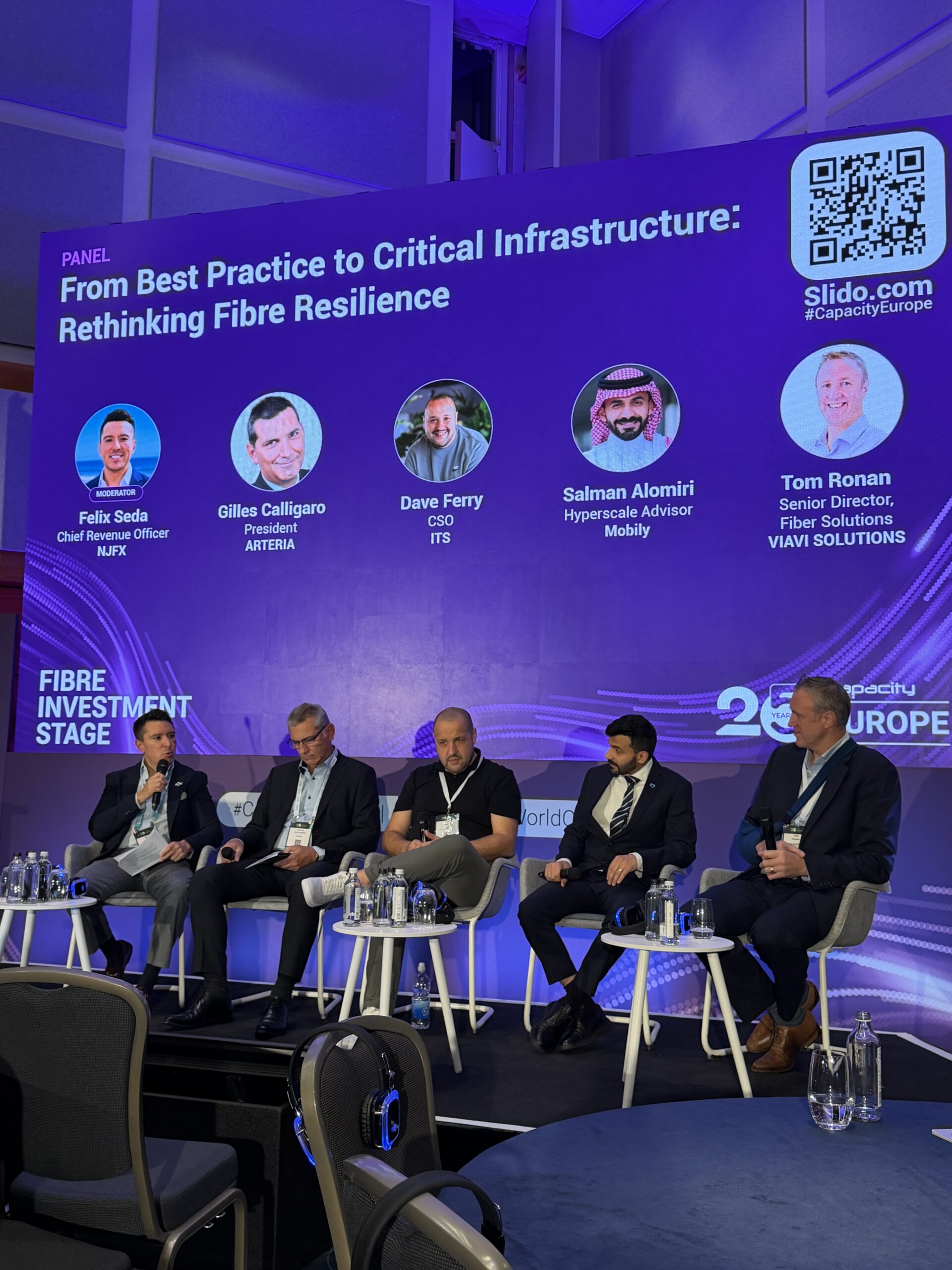
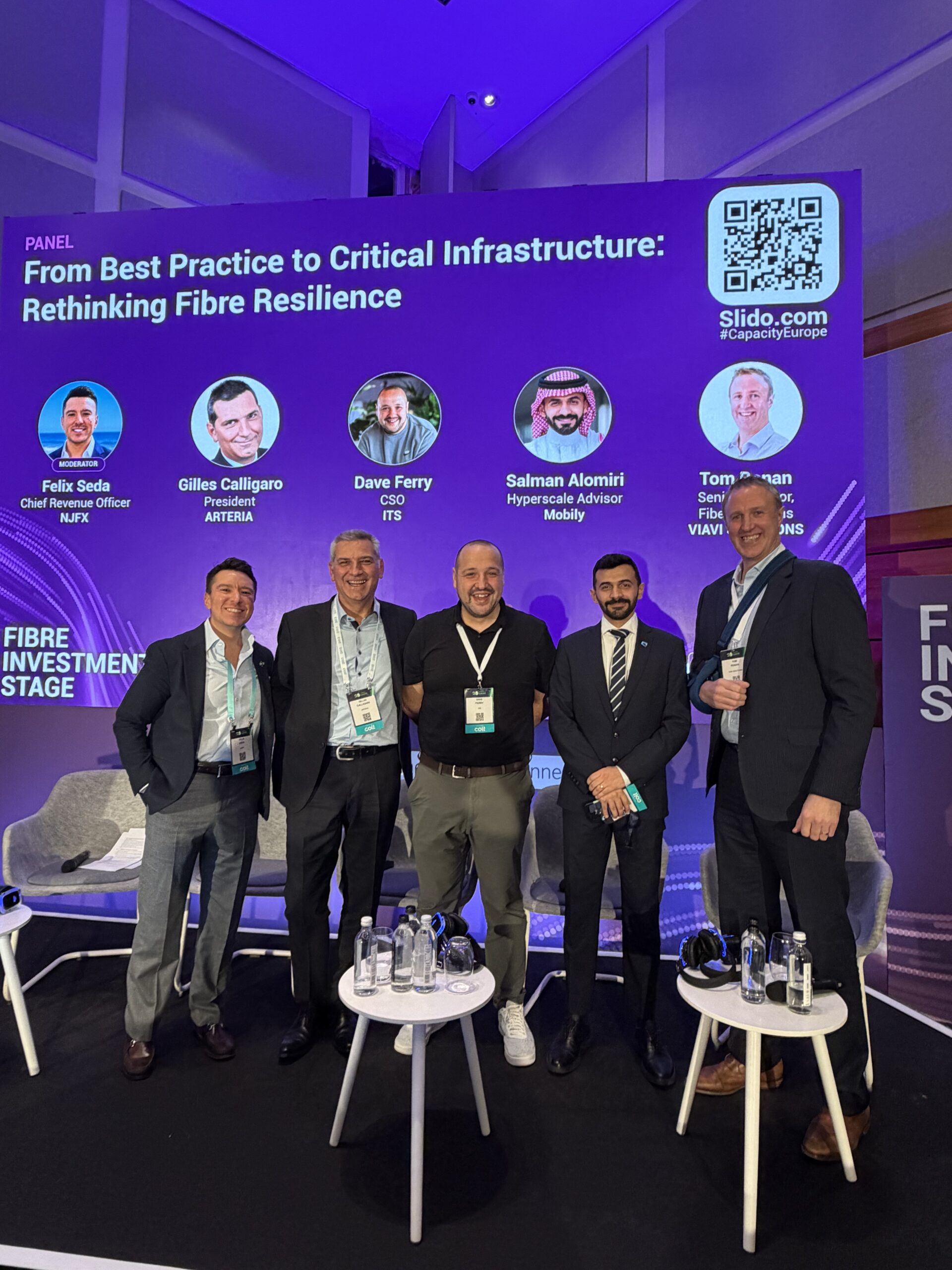
Lessons from "Best Practice to Critical Infrastructure: Rethinking Fibre Resilience," a panel moderated by NJFX CRO Felix Seda with leaders from Arteria, ITS, Mobily and Viavi Solutions.
Resilience is invisible until something breaks, and then it is the only thing that matters. That was the opening idea from NJFX CRO Felix Seda as he moderated "Best Practice to Critical Infrastructure: Rethinking Fibre Resilience" at Capacity Europe 2026 in London.
Over 40 minutes the panel covered what critical national infrastructure (CNI) grade actually means, where today's networks still fall short, and how to justify paying for something whose value only shows up on the worst day. Their answers add up to a clear message for anyone designing a network: resilience is not a feature you add later. It is an architectural decision you make from the start and prove every day after.
Fewer outages on aerial fiber than underground fiber, according to Arteria's experience on France's transmission grid.
Availability hyperscalers now demand, up from three nines in the last three to five years, and reaching toward seven.
Typical repair SLA to dispatch, diagnose and fix a fault anywhere on the network. Already tight, and tightening.
Four perspectives on resilience
What "CNI grade" really means
Critical national infrastructure used to mean the networks serving grids, hospitals and government. That definition no longer holds. As Salman Omeri pointed out, critical sectors now run on hyperscale cloud, so hyperscalers have had to inherit that criticality.
When Felix asked whether CNI grade is a design standard, a reporting standard or an operating standard, Tom Ronan's answer was all three, and then some.
It's not a standard; it's an ongoing operational condition.
Tom Ronan, Viavi SolutionsThree layers of CNI grade
- DesignPhysically diverse routes, built to a sound quality baseline: good splices, no water ingress, characterized from day one.
- OperationsContinuous visibility into the physical plant. "Data is king in the end. If I can't see it, I can't react to it."
- EvidenceThe ability to prove the condition of the network before, during and after an incident, across glass, equipment and services.
A network that checks the first box but not the other two is not CNI grade. It is a well-built network that nobody can vouch for.
Gilles Caligaro, whose network rides on RTE's high-voltage transmission pylons, put design first. Arteria's aerial fiber sees roughly seven times fewer outages than underground fiber, which is part of why EDF chose Arteria to connect France's nuclear plants.
Five lessons from the panel
Redundancy is not resilience
This was the line Felix wrote down from the prep call, and it framed the whole discussion. Having a backup path is redundancy. Knowing that backup path is healthy and ready to carry traffic is resilience.
Tom made the point with his own recovery from arm surgery: two arms on paper, but only one that was actually ready to serve. Networks are the same. Protection switching is only as good as the fiber it switches to.
Splices age. Insertion loss creeps up. Without monitoring of failover paths, lit or dark, a redundant route is an assumption, not a safeguard.
Diverse suppliers do not guarantee diverse routes
Asked about the industry's biggest blind spot, Dave Ferry described a UK outage where an auger drill wound a single fiber cable around its bit and pulled it out at the head end. That one cable carried traffic for multiple major providers across the south coast, and all of them went down together.
"The blind spot for the market is thinking that just because they've got different suppliers, it's definitely traversing different cables."
Dave Ferry, Chief Sales Officer, ITSTrue physical diversity means more than separate cables. If two paths share a duct, a route or a bridge, one strike takes out both. "Dig once" duct reuse has accelerated fiber builds, but it also concentrates risk. Ask for route maps, and ask where the pinch points are. As Dave put it: "Maybe it's triversity. Maybe it's quadversity," bringing satellite or mobile into the mix.
A checklist is not a test
Accreditations matter; Dave cited ISO 27001, ISO 22301 and Cyber Essentials as table stakes for business-grade fiber. But the real test is what happens when a cable is cut, a landing station drops, hardware fails or power goes out.
More cable is not more resilience
The Red Sea cable cuts were a recurring reference point. Adding fiber pairs along the same corridor does nothing when the corridor is the problem. Real resilience comes from multiple landing stations, multiple data centers, different rings and different technologies, with satellite or mobile as a backstop where it makes sense.
"Resiliency and diversity is not a luxury or an added feature anymore. It is as important as the capacity itself."
Salman Omeri, MobilyRepair time is part of the design
Every network eventually breaks, so recovery speed is part of resilience. Tom broke repair into three stages: time to dispatch, time to diagnose and time to repair, all inside a five to eight hour SLA. With AI workloads pushing fiber counts into the thousands of strands, that window gets tighter.
Gilles noted that Arteria benefits from RTE's own field teams handling repairs, and that AI-based outage prediction is becoming practical.
Paying for something you hope never to use
Felix called resilience what it is: insurance. Everyone needs it and nobody enjoys paying for it. The panel was candid about the tension.
Dave described a market where fiber is in a race to the bottom on price while customers still expect every feature. His answer is honesty. Telling a customer "there is a pinch point here, and fixing it costs this much" turns an abstract demand into a practical decision. He also drew a clear line between residential and business networks: residential users will complain about an outage but cope with it. "Businesses won't."
Tom framed the economics differently. Monitoring costs very little compared with civils, glass and equipment. It pays back in faster response, and its larger value is preventive: spotting a fragile splice or rising insertion loss early enough to schedule a planned repair.
"Seeing that before you get a trouble ticket call at 10 o'clock on a Friday night, and everybody has to react within five hours and it screws up the whole weekend."
Tom Ronan, Viavi SolutionsAcoustic sensing goes one step further, detecting a digger or unauthorized activity near a cable before it cuts. It is not something to deploy everywhere, Tom noted, but on the most critical routes it can stop an outage before it starts.
Salman reported that enterprise and hyperscale buyers will pay a premium when providers can show the full package: track record, availability data and proof of diversity.
Building resilience into your architecture
Taken together, the panel's advice translates into seven practical steps for anyone planning or buying network infrastructure.
- Map the physical path, not the contractConfirm where every route actually runs, including ducts, bridges and building entry points. Treat any shared segment as a single point of failure.
- Tier resilience by criticality"A small retail store may be able to go down for six hours without a problem. The data center can't." Match diversity, SLAs and spend to what each location can afford to lose.
- Diversify at every layerLanding stations, data centers, terrestrial routes, carriers and, where appropriate, satellite or mobile. Diversity in one layer does not cover a single point of failure in another.
- Monitor the backup as closely as the primaryFailover paths, including dark fiber, need ongoing health data so they are proven ready to serve.
- Test failure, not just complianceSimulate cable cuts, power loss and site outages on a regular schedule.
- Keep a live source of truthAs-built spreadsheets go stale. Current, verifiable network data lets you respond quickly and prove your resilience to customers.
- Plan for repairKnow your dispatch coverage, diagnostic tools and realistic repair windows before you sign an SLA.
The one step that closes the gap
Felix closed by asking each panelist for one concrete step. Their answers line up neatly with the framework above.
Resilience by design
Above everything else, build it in from the start.
Co-opetition
Operators compete one day and build solutions together the next. Sharing route information at the right time lets everyone use each other's infrastructure with confidence.
More routes, all diverse
More cable is not enough. Integrate with other players to build genuinely diverse paths.
Visibility
"Do you actually have a source of truth?" A real, current view of the network instead of spreadsheets that no longer reflect it.
Diversity built in, not bolted on
At NJFX, these principles are the reason a carrier-neutral cable landing station exists. Subsea cables, terrestrial carriers and data center capacity meet in one Tier 3 facility in Wall Township, New Jersey, so customers can build genuine route and carrier diversity into their architecture rather than inheriting someone else's pinch points.
As AI workloads and global cloud traffic raise the cost of every minute offline, resilience has moved from a line item to a design requirement. The question is no longer whether your network has a backup. It is whether you can prove that backup will be there on the worst day.
Planning a diverse route into or out of the New York metro?
Talk to the NJFX team about building route and carrier diversity into your architecture.
