Local Connections: Benefits of Direct Peering
Local Connections: Benefits of Direct Peering
November 29, 2016
In today’s hyper- connected world, content flows freely across the seemingly countless autonomous networks around the globe, making its way from data centers halfway across the world to our tablets, phones and other connected devices in the blink of an eye. In order for this to happen, multiple networks must connect – that’s where peering comes in.
While there are various types of peering, direct peering is often considered the most preferable as it enables enhanced network performance. When traffic is peered directly (or locally), it traverses the shortest path between two networks – allowing for lower latency and higher availability. Avoiding congested and disjointed peering landscapes, often associated with large cities, can also give networks a leg up.
These advantages are beneficial to a wide variety of customers however, they are particularly attractive to over-the-top (OTT) service providers whose apps and content are delivered over the Internet. Today’s consumers expect the ability to view high-quality content any time, anywhere, which means OTTs cannot risk added latency or potential choke points in the network. Direct peering enables these providers to meet their growing demands – and considering the time spent viewing content on connected devices has increased 719% since 2011, these demands are on the rise.
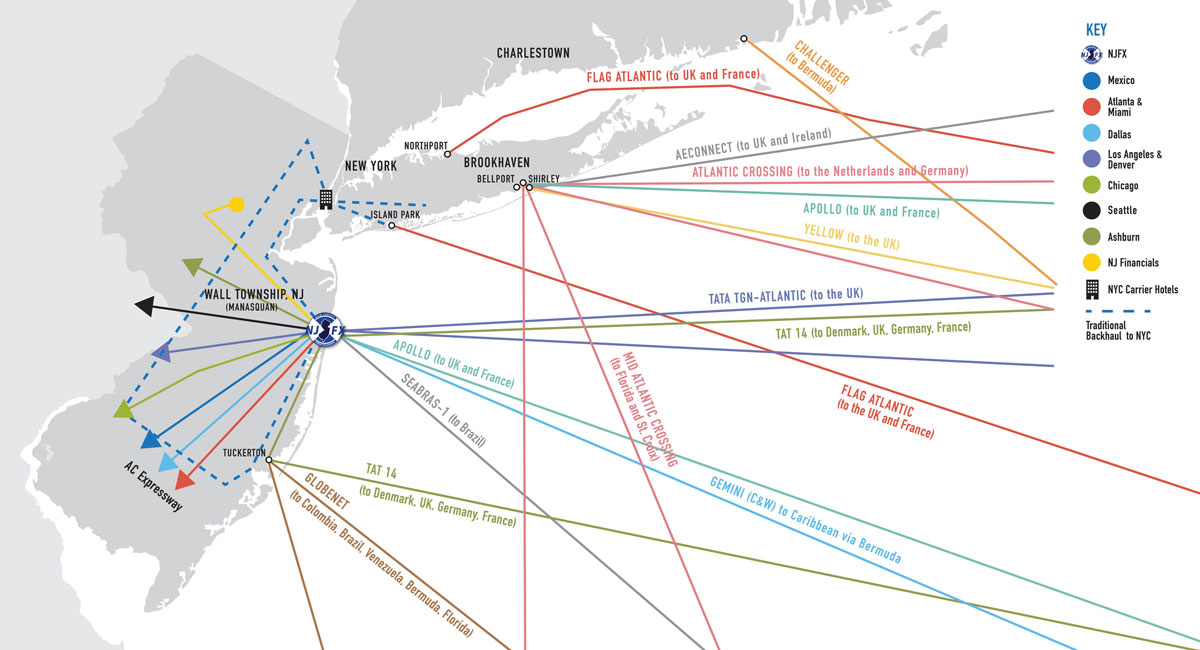
OTTs and network operators looking for peering opportunities on the Eastern seaboard with extensive international reach should look no further than NJFX’s brand new Tier 3 carrier-neutral colocation campus. NJFX offers tenants subsea access to leading service providers within Tata Communications’ CLS, which offers direct, redundant routes to Ashburn by five fiber-based providers. Customers have the opportunity to peer directly with high capacity, low latency networks without recurring cross connect fees. Moreover, NJFX is an ideal alternative to facilities in lower Manhattan. Routing traffic around New York City eliminates a potential choke point to the network, as its aging infrastructure poses a risk in the event of a force majeure.
Interested in direct peering through NJFX? Click here to contact us today.
###
About NJFX:
NJFX is a Tier 3 Carrier Neutral Cable Landing Station campus. Our colocation ecosystem has expanded to over 35 network operators offering flexibility, reliability, and security. Our Wall, NJ location provides direct access to multiple subsea cable systems giving our carriers diverse connectivity solutions and offers direct interconnection without recurring cross-connect fees.
More In the News
Aqua Comms and Epsilon Partner to Bring European Route Diversity and On-Demand Connectivity to NJFX’s Colocation Campus
Aqua Comms and Epsilon Partner to Bring European Route Diversity and On-Demand Connectivity to NJFX’s Colocation Campus Aqua Comms and Epsilon Partner to Bring European
Data Center Journal: INDUSTRY OUTLOOK: DATA CENTER DIFFERENTIATION
Data Center Journal: INDUSTRY OUTLOOK: DATA CENTER DIFFERENTIATION Industry Outlook is a regular Data Center Journal Q&A series that presents expert views on market trends, technologies and
NJ Business: NJFX Announces Plan to Expand Cable Landing Station Campus by Additional 48 Acres
NJ Business: NJFX Announces Plan to Expand Cable Landing Station Campus by Additional 48 Acres March 27, 2017 NJFX, the first Tier 3 carrier-neutral colocation
Data Center Knowledge: NJFX to Expand Jersey Data Center Campus that Links to Submarine Cables
Data Center Knowledge: NJFX to Expand Jersey Data Center Campus that Links to Submarine Cables NJFX says the amount of traffic has been “staggering” at
Capacity Magazine: NJFX announces 48-acre campus expansion
Capacity Magazine: NJFX announces 48-acre campus expansion The New Jersey Fibre Exchange (NJFX) has announced plans to expand its cable landing station campus by an
NJFX Expands its Campus Through the Development of Licensed Seats
NJFX Expands its Campus Through the Development of Licensed Seats NJFX seats are well-positioned for disaster recovery offering, only steps away from the Tier 3,
Local Connections: Benefits of Direct Peering Read More »