Local Connections: Benefits of Direct Peering
Local Connections: Benefits of Direct Peering
November 29, 2016
In today’s hyper- connected world, content flows freely across the seemingly countless autonomous networks around the globe, making its way from data centers halfway across the world to our tablets, phones and other connected devices in the blink of an eye. In order for this to happen, multiple networks must connect – that’s where peering comes in.
While there are various types of peering, direct peering is often considered the most preferable as it enables enhanced network performance. When traffic is peered directly (or locally), it traverses the shortest path between two networks – allowing for lower latency and higher availability. Avoiding congested and disjointed peering landscapes, often associated with large cities, can also give networks a leg up.
These advantages are beneficial to a wide variety of customers however, they are particularly attractive to over-the-top (OTT) service providers whose apps and content are delivered over the Internet. Today’s consumers expect the ability to view high-quality content any time, anywhere, which means OTTs cannot risk added latency or potential choke points in the network. Direct peering enables these providers to meet their growing demands – and considering the time spent viewing content on connected devices has increased 719% since 2011, these demands are on the rise.
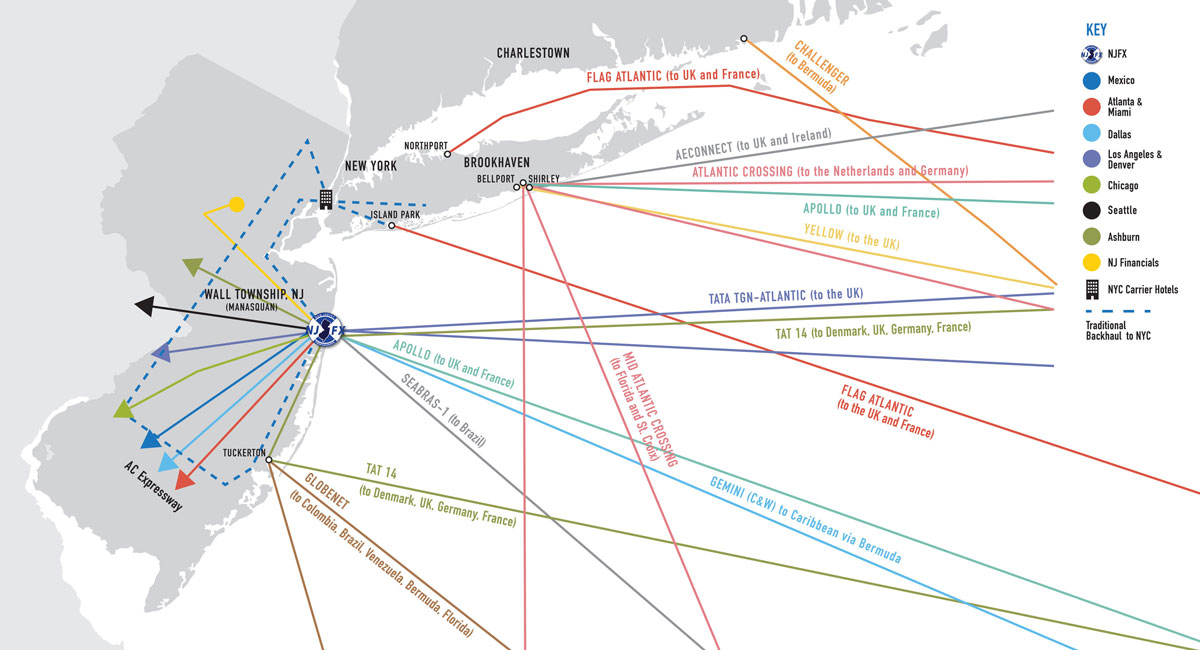
OTTs and network operators looking for peering opportunities on the Eastern seaboard with extensive international reach should look no further than NJFX’s brand new Tier 3 carrier-neutral colocation campus. NJFX offers tenants subsea access to leading service providers within Tata Communications’ CLS, which offers direct, redundant routes to Ashburn by five fiber-based providers. Customers have the opportunity to peer directly with high capacity, low latency networks without recurring cross connect fees. Moreover, NJFX is an ideal alternative to facilities in lower Manhattan. Routing traffic around New York City eliminates a potential choke point to the network, as its aging infrastructure poses a risk in the event of a force majeure.
Interested in direct peering through NJFX? Click here to contact us today.
###
About NJFX:
NJFX is a Tier 3 Carrier Neutral Cable Landing Station campus. Our colocation ecosystem has expanded to over 35 network operators offering flexibility, reliability, and security. Our Wall, NJ location provides direct access to multiple subsea cable systems giving our carriers diverse connectivity solutions and offers direct interconnection without recurring cross-connect fees.
More In the News
NJFX to Speak to its Edge Computing Network Strategy at Metro Connect 2017
NJFX to Speak to its Edge Computing Network Strategy at Metro Connect 2017 Media Alert Gil Santaliz CEO January 25, 2017 WALL, NJ – NJFX,
NJFX Celebrates a Successful Phase III Completion
NJFX Celebrates a Successful Phase III Completion January 16, 2017 WALL, NJ – January 17, 2017 – NJFX, the first Tier 3 carrier-neutral subsea colocation campus linking the United States,
451 Research Report – NJFX
451 Research Report – NJFX January 6, 2017 The 451 Research Group has put out a report on NJFX. The report can be found here: https://451research.com/report-short?entityId=91179
Q&A: Gil Santaliz, founder and managing member, NJFX
Q&A: Gil Santaliz, founder and managing member, NJFX Gil Santaliz, founder and managing member of New Jersey Fiber Exchange (NJFX), talks to Capacity about the
DataCenter Frontier: The Cloud Brings Colo to Cable Landings
DataCenter Frontier: The Cloud Brings Colo to Cable Landings As the cloud wars extend under the ocean, colo is coming to cable landings. At sites
Tata Communications Deploys Interconnection POP in NJFX’s Colocation Campus
Tata Communications Deploys Interconnection POP in NJFX’s Colocation Campus November 7, 2016 WALL, NJ – November 07, 2016 – New Jersey Fiber Exchange (NJFX), the first
Local Connections: Benefits of Direct Peering Read More »