Over the past decade, global data demand has accelerated at a pace that has fundamentally reshaped network architecture and the way digital infrastructure is designed, deployed, and operated. Hyperscalers, cloud service providers, content delivery networks, AI-driven workloads, and financial trading firms are generating unprecedented volumes of traffic that must move seamlessly across both subsea and terrestrial networks. This shift has pushed capacity requirements well beyond what legacy models were designed to support and has placed renewed focus on the physical locations where global connectivity converges.
Traditionally, a cable landing station (CLS) has functioned as a handoff point rather than an active network node. Once a subsea cable reaches land, traffic is typically transferred onto terrestrial backhaul and transported to a separate data center or internet exchange for routing, peering, and distribution. While this architecture has served the industry for decades, it introduces several structural limitations in today’s high-capacity environment. Backhauling traffic from the CLS to an external facility increases latency, adds operational complexity, and creates additional points of failure along the network path. It also concentrates risk along a limited number of terrestrial routes, reducing true diversity once traffic exits the landing station. From a security and resiliency standpoint, each additional handoff represents a new exposure point, particularly for latency-sensitive, regulated, or mission-critical workloads.
As traffic volumes continue to increase, so does the need for localized interconnection at the point of landing. Enterprises, content providers, financial networks, and cloud platforms are seeking to exchange traffic as close to the CLS as possible in order to minimize latency, reduce transport costs, and retain greater control over routing, performance, and security. This demand fundamentally challenges the passive CLS model and exposes its growing misalignment with modern network design. The traditional separation between subsea termination, terrestrial transport, and interconnection is becoming increasingly inefficient as port speeds rise and applications become more sensitive to delay and disruption.
NJFX has taken a fundamentally different approach by redefining the cable landing station as an active interconnection hub rather than a simple termination site. A critical component of this strategy is ownership and control of the front haul infrastructure. In 2024, NJFX acquired bore pipes from SubCom, allowing the company to directly own and manage the physical conduit between the beach manhole and the facility. By controlling this front haul segment, NJFX eliminates reliance on third-party infrastructure at one of the most sensitive points in the network path. This approach enhances security, increases resiliency, and provides greater operational certainty for subsea system owners and customers deploying critical capacity.
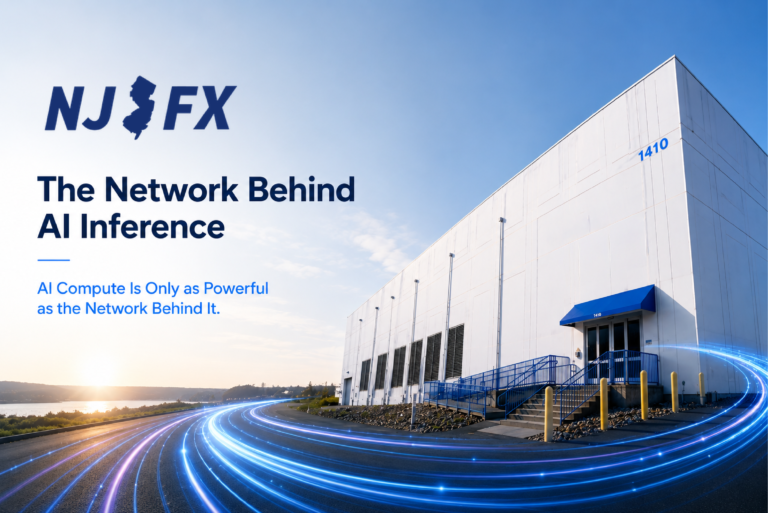
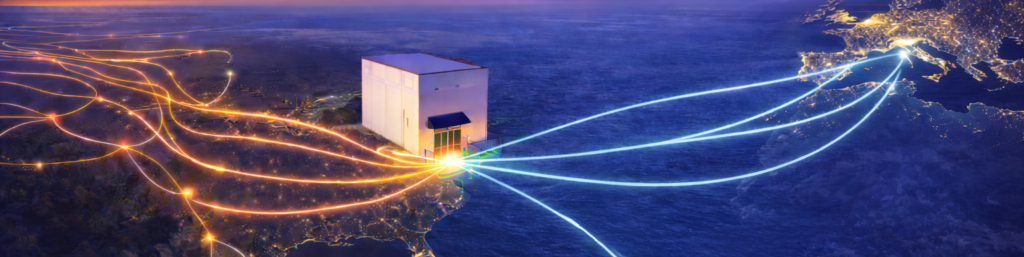
NJFX’s CLS and data center campus sits directly at the point of convergence between subsea systems and terrestrial networks. Rather than pushing traffic inland immediately, global networks can interconnect locally within the same secure facility where the cable lands. Traffic can be exchanged, routed, and distributed without unnecessary transport hops, reducing latency and minimizing dependence on legacy backhaul architectures. Multiple diverse points of entry further strengthen physical and network diversity, while keeping routing decisions close to where traffic enters the United States.
This model has enabled NJFX to support traffic at a scale rarely seen at a cable landing station. Today, more than 250 terabits per second of live traffic transits the NJFX campus, reflecting the shift from legacy architectures to high-capacity, high-density environments. Networks have moved well beyond 10G and 100G deployments. As demand for data-intensive workloads such as generative AI, real-time analytics, high-frequency trading, and cloud-native applications continues to grow, 400G has become the operational baseline. At the same time, active planning is underway across the industry for 800G interfaces and spectrum-based capacity strategies to further maximize fiber utilization and future-proof network investments.
This level of traffic concentration is made possible by combining direct access to four subsea cable systems with a dense, carrier-neutral interconnection ecosystem. NJFX supports more than 35 network operators and connects to 28 terrestrial fiber networks leading to major metro hubs throughout the Northeast and beyond. Traffic entering the facility benefits from four diverse points of entry, enhancing resiliency while maintaining proximity to population centers, cloud regions, and financial markets. By consolidating subsea landing, interconnection, and terrestrial access within a single campus, NJFX enables efficient traffic exchange at scale.
Supporting hundreds of terabits per second of live traffic also requires infrastructure engineered for long-term growth. Expansion at NJFX is reflected not only in increasing port speeds, but in the evolution of the physical environment itself. Higher-density switching and routing platforms drive increased rack power requirements, greater cross-connect density, and the need to scale from single cabinets into private cages and integrated network environments. These changes are planned in parallel with ongoing discussions around 800G optics, spectrum-based capacity planning, and future optical transport upgrades, ensuring that the facility remains aligned with the direction of global network evolution.
As the global subsea network continues to expand, with hundreds of cable systems active or under development worldwide, the question facing operators is no longer simply where capacity lands. The more pressing question is where that capacity can be efficiently exchanged, securely managed, and scaled over time. Most cable landing stations will continue to operate as passive sites, feeding traffic into traditional data centers and exchange points. NJFX represents a different path, one that aligns the landing of subsea capacity with the realities of modern, high-capacity network design.
With new subsea systems coming online and the addition of a 10MW data hall within the NJFX campus, demand for capacity, interconnection, and localized traffic exchange is expected to continue growing. In an era defined by scale, resiliency, and performance, bringing interconnection directly to the cable landing station is no longer an edge case. It is a purpose-built model designed to support the future of global connectivity.